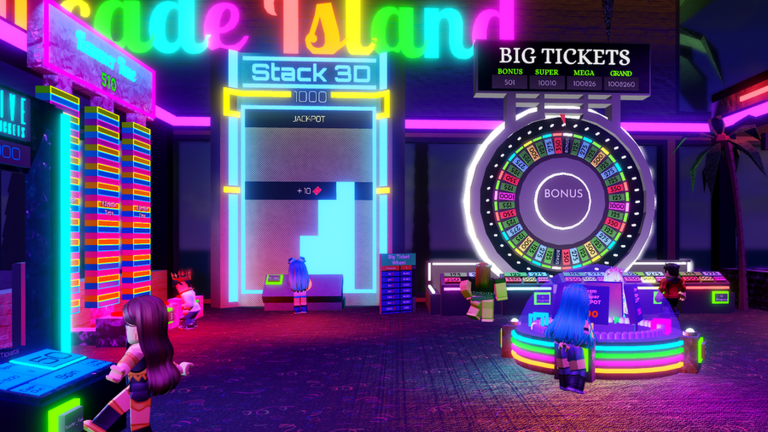

Arcade Island works because it understands that not every social Roblox game needs to fake epic depth. The pitch is much simpler: step into an island packed with machines, spend credits, build tickets, and turn that into prizes while the map doubles as a casual hangout.
What keeps it enjoyable is the balance between minigames and atmosphere. One minute you are testing which attraction pays better, the next you are just moving through the space, seeing what the lobby is doing, and deciding whether to save for the Prize Hub or throw your balance into another round. That mix keeps the game from feeling like a children's casino screen or an empty roleplay map.
This is a better fit for players who want light, social Roblox sessions with no heavy commitment. It is not built around huge tension, but it works well for short play windows, prize collecting, and that kind of routine where the setting matters almost as much as the main mechanic.
316.6K
Favorites
60.2K
Upvotes
16.7K
Downvotes
How to play Arcade Island
Arcade Island runs on a simple loop: walk around the island, collect or buy credits, jump into arcade machines, and build up tickets to trade for prizes. Instead of pushing a strict campaign, the game works more like a park where each attraction gives a different kind of payoff.
- The safest start is testing the simpler machines first, because they teach the flow between spending credits, earning tickets, and deciding whether it is worth staying on the same attraction.
- The map matters too. Beyond the main arcade floor, the island has room to wander, hang out, and break the feeling of doing nothing but machine after machine.
- If you plan to stay longer, pay attention to which minigames seem to return tickets more steadily instead of sprinting to the flashiest one.
- Once your balance starts growing, think about the Prize Hub. Tickets only matter when they turn into something you actually want to keep.
Codes & Tips of Arcade Island
Right now, Arcade Island does not revolve around a strong, reliable list of public codes the way many Roblox games do. This field is more useful for practical tips, because progress depends far more on how you spend credits and choose machines than on redeeming coupons every session.
The best shortcut is treating your early credits like a yield test. If one machine eats a lot and returns very little in tickets, swap out early instead of forcing it just because it looks better. Another good habit is joining with a short goal in mind, such as saving for one specific prize, because that stops your balance from disappearing into random runs that do not move anything forward.
Tips for Arcade Island
Arcade Island feels better when you treat the island as a place for small decisions instead of trying to auto-farm everything.
- Before burning your whole balance, play a few short rounds on different machines and compare the ticket return. The best early machine is not always the one drawing the biggest crowd.
- If you are playing with other people, use the social rhythm of the map. A lot of players find the better-paying minigames just by watching where others keep going back.
- Do not leave tickets sitting around with no plan. Once a prize actually makes sense for your account, having a clear target helps more than testing every machine at random.
- If the arcade floor starts feeling repetitive, walk the island for a bit. Part of Arcade Island's charm is that it does not feel like a stacked menu of minigames.
Curiosities about Arcade Island
Arcade Island sits in a very specific corner of Roblox, closer to a social park than to a straight simulator.
- The official page highlights a mix of gaming, roleplay, and an island setting, which makes it clear the game wants to be both a hangout space and an arcade floor.
- Community wikis usually break progression into Credits, Tickets, and the Prize Hub, showing how reward exchange is the real backbone of the game.
- The map also leaves room for side roles, including food service and café work, which helps the lobby feel more like a place to spend time than a queue of machines.
Progress & Economy of Arcade Island
Arcade Island's progression turns on Credits, Tickets, and prizes. Credits are the fuel for each run. Tickets are the return that tells you whether staying on a machine makes sense. Prizes are what convert that loop into collection and purpose.
That gives the account a light-efficiency economy rather than a power spike economy. Players improve by learning where their credits go farther, how many tickets they want to save, and when it makes sense to cash out at the Prize Hub. It is a park-and-reward economy, not a combat or build-heavy one.
Useful links for Arcade Island
Images
Related posts