
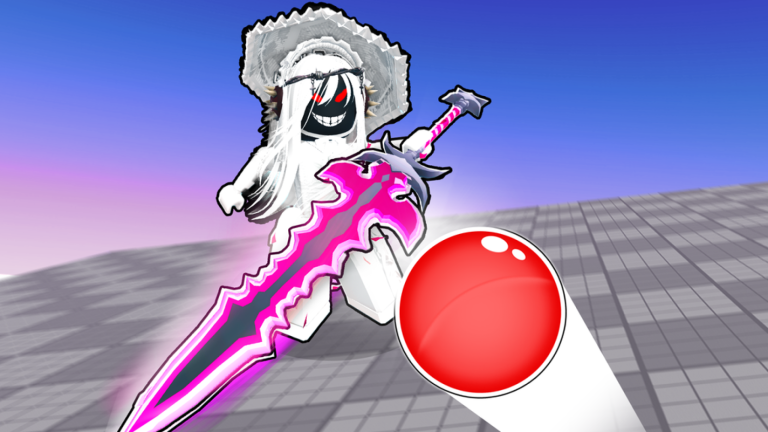
Blade Ball
Blade Ball turns a small idea into a pure nerve arena: deflect a homing ball at the right instant, survive the rising speed, and use your ability when the exchange starts slipping out of control.
Blade Ball works because it reduces the fight to a moment everyone understands and almost nobody holds forever: the instant of sending a homing ball back before it turns into your elimination. That clarity makes the match easy to enter, but the rising speed stops it from feeling shallow.
What keeps the game interesting is everything between one block and the next. The arena becomes target reading, small repositioning, and ability use inside an exchange that keeps changing hands. Once the ball speeds up, the duel stops being only reflex and starts becoming nerve, calm, and angle choice.
That is why Blade Ball works for both players who want immediate action and players who enjoy sharpening a tiny loop until it becomes serious skill. The premise fits in one sentence, but surviving it is much harder than it first sounds.
12.4M
Favorites
8.1M
Upvotes
562.4K
Downvotes
How to play Blade Ball
Blade Ball runs on one clear rule: block at the right moment to send the ball back and avoid becoming the next elimination. Everything else grows out of that pressure, because every return makes the exchange faster and every mistake more expensive.
First steps
- Learn the timing of the block before trying to style with abilities.
- Watch who becomes the target after each return, because that changes the positioning of the whole arena.
- Use your first rounds to understand how the speed ramps up and when the exchange stops feeling comfortable.
Public controls listed on the official page: F or click to block, Q for ability, Shift for shift lock, and R for emote.
Codes & Tips of Blade Ball
Right now Blade Ball does not highlight active public codes as strongly as it highlights the fight itself. What helps more are a few practical tips tied to reading and positioning.
- Do not stand still in the middle once the speed starts rising. A small angle adjustment already changes your chance of getting a clean deflect.
- Abilities work better when they break the rhythm of the exchange instead of being used in panic.
- When the target changes, reading the new line of the ball before running usually saves more rounds than blind reflex.
Tips for Blade Ball
Blade Ball rewards players who read the full exchange more than players who try to solve everything with raw reflex.
Block with margin, not in panic
A lot of mistakes come from waiting too long and trying to return the ball on the last possible frame. Living on the edge makes the whole round more fragile.
Use abilities to create real advantage
If a skill does not change the other side’s read, it often becomes nothing more than a pretty effect and a wasted cooldown.
More speed changes the value of space
The faster the ball gets, the more expensive bad positioning becomes.
Curiosities about Blade Ball
The official description frames Blade Ball as a game of focus, timing, and strategy, which matches how the entire arena revolves around a single projectile. Instead of filling the map with many systems at once, it concentrates tension inside one exchange that keeps accelerating.
Another interesting detail is how it speaks to both casual play and leaderboard competition. The same simple premise supports short sessions and serious consistency play.
Progress & Economy of Blade Ball
Blade Ball grows through abilities, upgrades, weapon skins, and finisher effects. Account progress does not replace timing, but it changes how a player pressures, protects, and presents themselves in the arena.
That progress makes more sense when it follows your actual playstyle. Players who understand the rhythm of the exchange usually get more out of the system than players who upgrade blindly.
Images
Related posts


