
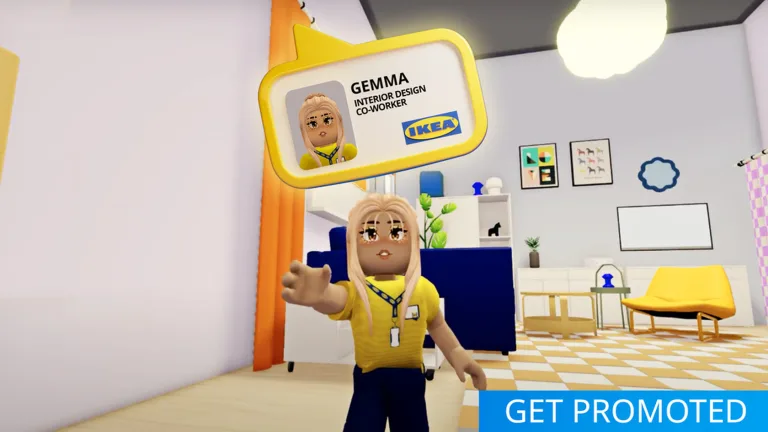
IKEA: The Co-Worker
IKEA: The Co-Worker turns the brand's store into a playable Roblox space, blending themed atmosphere, light tasks, and a soft workplace fantasy built around the IKEA floor itself.
+6
IKEA: The Co-Worker works because it understands that a brand experience needs more than attractive decoration. Instead of stopping at a static showroom, it tries to turn the store into a place of movement, small responsibilities, and a light workplace fantasy, which makes the session much more engaging than a simple promotional walk.
That choice gives the project its identity. You are not only there to look at products; you are there to play at being part of that world. Once that clicks, the environment stops acting like a backdrop and becomes the central mechanic, even if the loop stays simple and accessible.
That is also why the game works best when read as themed simulation. Its value is not in intense competitive objectives but in exploring, interacting, and noticing how IKEA translated its identity into Roblox. For a branded game, that kind of adaptation goes a long way toward making the project feel alive.
183.4K
Favorites
20.9K
Upvotes
3.1K
Downvotes
How to play IKEA: The Co-Worker
The best way to enter this one is to treat it as a themed simulation rather than a goal-heavy game. Walk through the spaces, see how each area is staged, and test the activities on offer so you can feel how the map translates store life into something more playful.
How to get more out of it
This kind of project works better when you mix curiosity with interaction. Slow exploration helps the environment land, while stepping into a role and playing with the tasks gives the store more life than a simple tour through a digital showroom.
Codes & Tips of IKEA: The Co-Worker
The most useful tricks here are really about reading the project on its own terms.
- Enter it like a guided playable visit: looking for a hard ending too early usually flattens the experience.
- Try different roles: part of the fun comes from seeing how each activity shifts the mood.
- Watch the server energy: in fuller rooms, the social side of the environment usually becomes much stronger.
- Read the map as brand staging: many details land better when you pay attention to how IKEA wants to present itself here.
Tips for IKEA: The Co-Worker
- Brand projects usually work better when you buy into the space fantasy instead of forcing them into a heavy tycoon mindset.
- If the server is active, using the map as a social meeting point often improves the session a lot.
- Try different parts of the store before repeating the same interaction, because the map sells variety through circulation and roles.
Curiosities about IKEA: The Co-Worker
IKEA: The Co-Worker stands out because it does more than display products. The experience tries to sell the idea of everyday life inside the store, which shifts the focus from furniture alone toward role, routine, and shared presence within that branded world.
That matters on Roblox, where many brand activations stop at a pretty set. Here, the concept feels stronger because it turns stylized work, social presence, and themed movement through the store into the main attraction.
Progress & Economy of IKEA: The Co-Worker
The most important progression here is not a heavy in-game economy but a broader interaction range. A session gets better when you understand the different spaces, discover which activities are more fun, and use the store more intentionally, whether alone or with other players.
In this kind of experience, progress shows up less in numbers and more in how well you use the space. Players who read the map's premise, switch between tasks, and lean into the atmosphere usually get much more out of the visit than players who cross it like a static catalog.
Videos
Images
Related posts


