
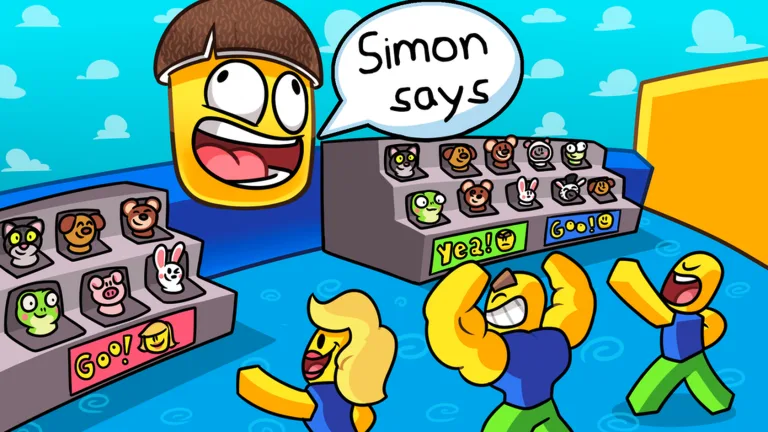
Silly Simon Says
Silly Simon Says is a fast party game built around quick commands and goofy minigames, where attention, timing, and trap reading matter more than raw reflexes.
+5
Silly Simon Says understands that a party game does not need a heavy system to work. Its strength comes from fast instructions, short minigames, and a constant willingness to turn a misread command into shared chaos. When the room leans into the joke, the match almost runs on its own.
That works because the game knows how to play with a familiar rule. Everyone thinks they understood the instruction already, but the trap usually hides in a small wording detail, in the timing, or in the sudden shift of tone from one round to the next. The result is a kind of light tension that is more funny than punishing, and it stays engaging because it keeps making players doubt their own impulse.
That is where Silly Simon Says is strongest: not as a hard technical challenge, but as a social game driven by reactions, funny mistakes, and quick reading of nonsense. If you like party games where the joke is in both the command and the room's response, this is very well-calibrated chaos.
554.6K
Favorites
183.9K
Upvotes
40.6K
Downvotes
How to play Silly Simon Says
The opening feels easy, but the round usually punishes the players who react too fast. The best habit is to hear the full instruction, confirm whether the game really asked for that action, and only then move. In Simon Says, a huge share of eliminations comes from rushing, not from the minigame being difficult.
How to last longer
It also helps to expect constant shifts in tone. One round may ask for precision, while the next turns into a joke for the whole lobby. Players who adjust to that rhythm and catch when the game is setting a trap usually outlast the ones trying to solve everything on instinct alone.
Codes & Tips of Silly Simon Says
The strongest tricks here are mental ones. A useful habit is waiting a fraction longer before obeying commands that sound too obvious, because many losses come from misreading instructions or from bait designed to punish players who accelerate before thinking.
It also helps to watch the kind of trolling the room has already seen in earlier rounds. Once you notice the pattern of fake-outs, you start filtering what is a real instruction, what is noise, and when the game is testing attention rather than speed.
Tips for Silly Simon Says
- The fastest player does not always go the furthest; in Simon Says, reading usually beats reflex.
- When the minigame changes tone, try to adapt with it instead of repeating the behavior that worked one round earlier.
- Laughing at the chaos is part of the fun, but the players who read the trick first usually turn that lightness into a real advantage.
Curiosities about Silly Simon Says
Part of Silly Simon Says' charm is that the best memory of a session is often not the final win. What sticks is usually the round where half the server fell for the same absurd command or the minigame where everyone understood too quickly and failed together.
That is why the game works far more as a social experience than as pure competition. Its value lives in shared chaos, reactions, and those moments where the whole lobby buys into the joke at once.
Progress & Economy of Silly Simon Says
Formal economy matters less here than the value of a well-played round. The game rewards attention, adaptation, and prank reading more than any complex accumulation system, so progress is mostly felt in how often you stop falling for twisted orders and sudden rhythm changes.
In practice, Silly Simon Says becomes richer through session flow. Every strong round creates a little group memory, and that social carry ends up being the main reason to keep playing even though the system itself stays light.
Videos
Images
Related posts


