
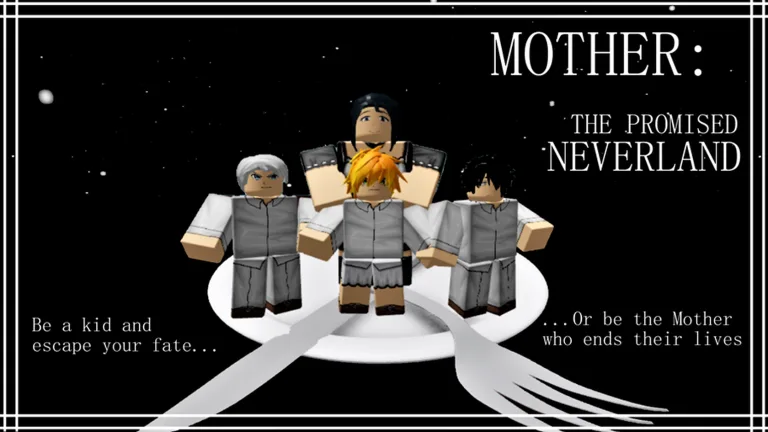
Mother: TPN
A round-based survival game inspired by The Promised Neverland, where kids blend in with NPCs, craft escape tools, and try to get out while Mother hunts for real players.
Mother: TPN works best when you realize the horror comes less from jump scares and more from suspicion. Each round puts children inside an orphanage, trying to act like NPCs, while Mother watches behavior, follows clues, and tries to find out who is pretending before an escape happens.
As a Kid, the match becomes a mix of acting and preparation. You talk to NPCs for tasks, read books to unlock recipes, gather items like bed sheets, sticks, rocks, and bandages, then turn them into escape tools. The hard part is doing all of that without standing out, because running, taking strange routes, or touching the wrong thing can expose your role.
As Mother, the game flips. The fun is in reading who behaves differently from NPCs, using the tracker carefully, and writing names at night only when you are sure. Players who like social survival, disguise, slow pursuit, and round-based tension will get more from it than players looking for constant direct action.
433.5K
Favorites
88.1K
Upvotes
12.7K
Downvotes
How to play Mother: TPN
The round revolves around two main roles. If you are a Kid, you need to look like an NPC while preparing your escape; if you are Mother, you need to identify which children are players before they get out.
First steps
- As a Kid, talk several times to the same NPC to receive tasks and basic items.
- Read bookshelves to unlock recipes; without them, escape options are much more limited.
- Use resources such as bed sheets, rocks, sticks, and bandages to craft tools like rope, shovel, knife, or zipline.
- Avoid running for no reason. The official description mentions double W to run, but strange movement can reveal that you are not an NPC.
- As Mother, watch patterns, use the tracker, and confirm names at night instead of accusing on impulse.
Codes & Tips of Mother: TPN
There are no reliable public Mother: TPN codes right now. What actually helps are tricks tied to behavior, crafting, and round reading.
- As a Kid, do not perform every escape step in a straight line. Mixing normal movement with tasks makes Mother less likely to read your route.
- Read books early, because locked recipes can leave useful items without a purpose when escape time comes.
- Bed sheets matter because they connect to crafts such as rope and knife; do not treat them like random filler.
- As Mother, notice who repeats conversations, turns for no reason, or runs at the wrong time.
Tips for Mother: TPN
Mother: TPN rewards patience. Players who move too fast become obvious, and players who observe too little let the round slip away.
Kids need to act before escaping
The common mistake is looking like a player in the first minutes. Do tasks, read the map, and speed up only when the escape is closer.
Crafting decides the route out
Rope, Shovel, Zipline, and Knife each support a different escape plan. Knowing what each item opens keeps you from carrying material that does not solve your route.
Mother wins on small differences
A Kid usually gives themselves away through a detail: repeated talking, impatient movement, or a choice an NPC would not make. Reading that is worth more than chasing everyone.
Curiosities about Mother: TPN
Mother: TPN is based on Yakusoku no Neverland, also known as The Promised Neverland. That explains the orphanage, the pressure to look like an ordinary child, and the need to escape before becoming demon food.
The game also separates the two round fantasies clearly. Kid plays by hiding intent and preparing tools; Mother plays as a social hunter, trying to discover real names inside a crowd of NPCs.
Progress & Economy of Mother: TPN
Progress shows up through points, perks, and stats. Escaping as a Kid earns points, while Mother also earns by sending children to the demons. The community wiki separates low-quality and high-quality farms, with higher-value rounds giving better rewards.
Those points matter because they can feed into rerolls for attributes such as IQ and Strength. IQ supports recipe learning, while Strength affects stamina and movement, so the account's rhythm changes depending on the profile you roll.
In practice, progress is not only cosmetic. A child with recipes unlocked, good items, and useful stats escapes much more safely; a patient Mother turns tracker use, night timing, and social reading into captures.
Useful links for Mother: TPN
Images
Related posts


